Microsoft's VS Code codebase compiles in 7.5 seconds under the TypeScript 7 native preview, versus 77.8 seconds with the current JavaScript-based compiler. That's a 10× improvement, and it's the headline result of Project Corsa, Microsoft's full rewrite of the TypeScript compiler and language service in Go.
TypeScript 7 changes that. Or rather, it will, but the preview is already here, and the numbers are hard to argue with.
Project Corsa: The Native Port
In early 2025, Microsoft announced Project Corsa, a full native port of the TypeScript compiler and language service to Go. The goal was ambitious: ~10x faster build times and significantly improved editor responsiveness.
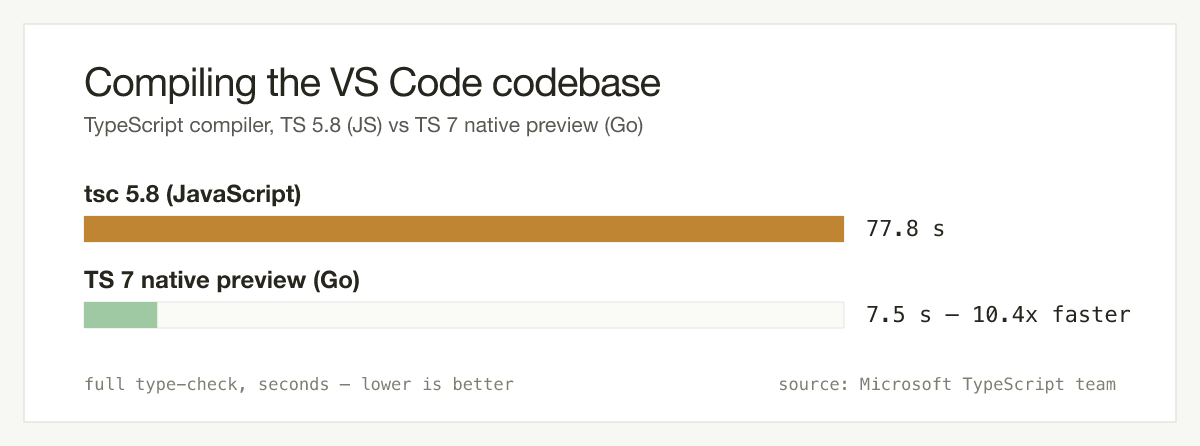
The initial benchmarks were striking. On the VS Code codebase itself, a large, real-world TypeScript project, compilation dropped from 77.8 seconds to 7.5 seconds. On the Playwright test suite, it went from 11.1 seconds to 1.1 seconds. These aren't synthetic micro-benchmarks. They're the same codebase Microsoft uses to build VS Code, running on the same hardware.
The port isn't complete yet. TypeScript 6.0 remains the JavaScript-based release that the ecosystem transitions through. Microsoft has indicated that TypeScript 6.0 will be the last major version built on the JS-based toolchain. TypeScript 7 is where the native era begins in earnest.
What "Native" Actually Means in Practice
There are two dimensions to what TypeScript 7 changes, and it's worth separating them.
The compiler (tsc), The command-line TypeScript compiler. A Go-based tsc means faster compiles, lower memory usage during builds, and better integration with non-JavaScript toolchains. For projects that run tsc as part of CI pipelines, this translates directly into faster feedback cycles.
The language service, This is what powers VS Code's IntelliSense, error underlining, jump-to-definition, and refactoring. Editor performance is bottlenecked on the language service, not the compiler. Microsoft reports that project load times have decreased roughly 8x in early testing. For anyone who has waited 30+ seconds for a large TypeScript project to become responsive in VS Code, that number matters.
Node.js Type Stripping: Running TypeScript Without Transpiling
In parallel with the native compiler work, Node.js has been shipping native TypeScript support through a feature called type stripping. This is a fundamentally different approach to running TypeScript, instead of compiling .ts files to .js, Node.js can now execute TypeScript directly by stripping type annotations before execution.
The timeline moved fast:
- Node.js 22.18.0 (July 2025) enabled type stripping by default
- Warnings were removed in v24.3.0/22.18.0
- The feature stabilized in v25.2.0
The key distinction is between erasable syntax (types, interfaces, anything that disappears at runtime) and runtime syntax (enums, namespaces, things that produce actual JavaScript). Type stripping works cleanly for the former. For the latter, the Node.js team has introduced a --erasableSyntaxOnly flag that enforces this separation explicitly.
This means you can now write a TypeScript file and run it with node file.ts, no build step, no transpilation. For scripts, CLIs, and quick prototyping, this is a meaningful workflow improvement. For production builds, you'll still want tsc for cross-targeting and full type checking, but the gap between "I want to try something" and "running code" shrinks considerably.
What Developers Need to Do Now
The transition isn't automatic, and there are concrete steps worth taking ahead of the shift:
Audit enum and namespace usage. These are the TypeScript features that don't have a clean erasable equivalent. Enums can be replaced with as const objects; namespaces can migrate to ES modules. If your codebase uses either heavily, start the migration now.
Enable --erasableSyntaxOnly in CI. This flags any non-erasable TypeScript syntax in your codebase, giving you a clear migration roadmap before type-stripping becomes the default behavior.
Add TypeScript 7 preview to CI pipelines. The @typescript/native-preview npm tag lets you test the Go-based compiler against your codebase today. It won't replace your production build yet, but it surfaces any issues before the migration lands.
Watch for strict-by-default changes. TypeScript 6.0 is considering making strict mode the default for new projects. If you've been putting off enabling strict checks, now is the time, it won't be optional much longer.
The Bigger Picture
Two forces are converging. The first is compiler performance: a native TypeScript compiler solves the biggest pain point in the day-to-day developer experience, slow editor startup and sluggish type-checking in large codebases. The second is runtime support: Node.js running TypeScript natively removes the last friction point between writing a type-annotated file and executing it.
Together, they move TypeScript from "a language that compiles to JavaScript" toward something closer to a first-class systems language for the JavaScript ecosystem. Whether that's a good thing depends on your perspective, but the direction is clear, and the performance gains are real.
The JavaScript-based TypeScript era isn't over yet. But TypeScript 7, with its Go-based compiler and the Node.js type-stripping feature it enables, is the beginning of a different chapter.