numpy-ts, the most comprehensive NumPy implementation written entirely in TypeScript, has released version 1.2, and the headline is not speed. It is something stricter: given the same seed, numpy-ts now produces exactly the same random numbers as NumPy, bit for bit. Alongside that, the release adds first-class Float16 support and collapses the per-runtime entry points into one package that works everywhere.
What numpy-ts is trying to solve
Python's NumPy is the de facto standard for array computing, linear algebra, signal processing, data preprocessing for machine learning. Bringing that API to TypeScript has obvious appeal for web-based tools, notebooks, and browser-native data apps.
The hard part has never been the API surface; it is matching NumPy's behavior. numpy-ts approaches this by validating against NumPy directly: over 6,000 tests compare its output with the real thing, across arithmetic, FFT, linear algebra, and random distributions. Coverage sits at roughly 94% of the NumPy API, 476 of 507 functions, which makes it the most complete port in the JavaScript ecosystem by a wide margin.
The RNG story: identical, not similar
Before 1.2, numpy-ts used approximations of NumPy's random number generation, close enough for casual use, but sequences diverged from NumPy after the first few values. For scientific work, that is disqualifying: you cannot reproduce a paper's experiment, port a test fixture, or verify a migration if seed(42) gives you different numbers.
Version 1.2 reimplements the generators to match NumPy bit for bit:
import { random } from 'numpy-ts';

const rng = random.default_rng(42);
rng.random(3);
// [0.7739560485559633, 0.4388784397520523, 0.8585979199113825]
//, the exact same three numbers NumPy prints for default_rng(42)
If you are porting a NumPy pipeline and your tests assert on seeded random data, those fixtures now transfer unchanged.
Float16, without native support
Float16 (half-precision) uses 16 bits per number and has been a fixture of GPU inference for years, memory bandwidth is usually the bottleneck, and half precision is often plenty. JavaScript has no native float16 type, so numpy-ts implements the conversion and storage itself, slotting it in alongside Float32, Float64, the integer dtypes, and complex numbers.
One package, every runtime
Until now, different runtimes needed different entry points, one import for Node, another for browsers. Version 1.2 unifies them: one package that behaves identically on Node.js, Bun, Deno, and in browsers, at about 93 kB minified and gzipped with zero dependencies.
So how fast is it, honestly?
Here is the part worth being precise about: numpy-ts is not close to native NumPy performance, and its author does not claim otherwise. NumPy gets its speed from decades-old C, BLAS, and LAPACK; a pure TypeScript implementation runs on average about 15x slower. The roadmap targets algorithmic optimizations and selective WebAssembly for hot paths.
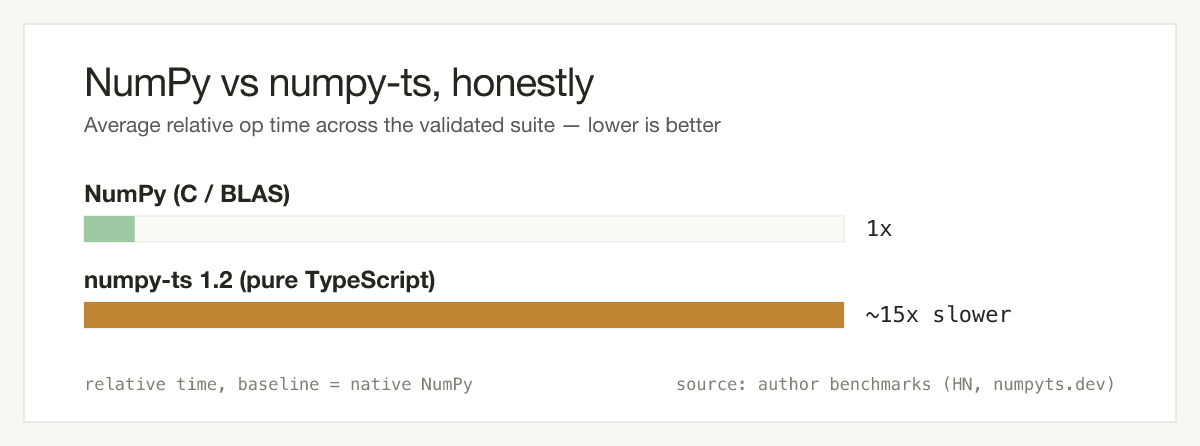
In practice the gap matters less than it sounds for the library's actual use cases, cleaning a dataset in a browser tool, computing summary statistics, running a small matrix operation in a visualization. It matters a lot if you try to do real numerical computing on large arrays. Know which case you are in.
API compatibility with NumPy
The project's goal is API compatibility, not just the concepts, and the migration guide shows side-by-side translations. Most code maps directly:
import numpy as np

a = np.array([[1, 2], [3, 4]])
b = np.linalg.inv(a)
c = np.dot(a, b)
d = np.sum(a, axis=0)
import { array, linalg, dot, sum } from 'numpy-ts';

const a = array([[1, 2], [3, 4]]);
const b = linalg.inv(a);
const c = dot(a, b);
const d = sum(a, { axis: 0 });
Getting started
npm install numpy-ts
No runtime dependencies, works in Node.js (CommonJS and ESM) and modern browsers. Full documentation, the migration guide, and the API reference live at numpyts.dev, with the source at github.com/dupontcyborg/numpy-ts.

![Oxc v0.135 Lands the React Compiler Rust Port and a `#[non_exhaustive]` AST Break](/_ipx/_/images/heroes/2026-06-12--oxc-v0-135-react-compiler-ast-breaking.png)