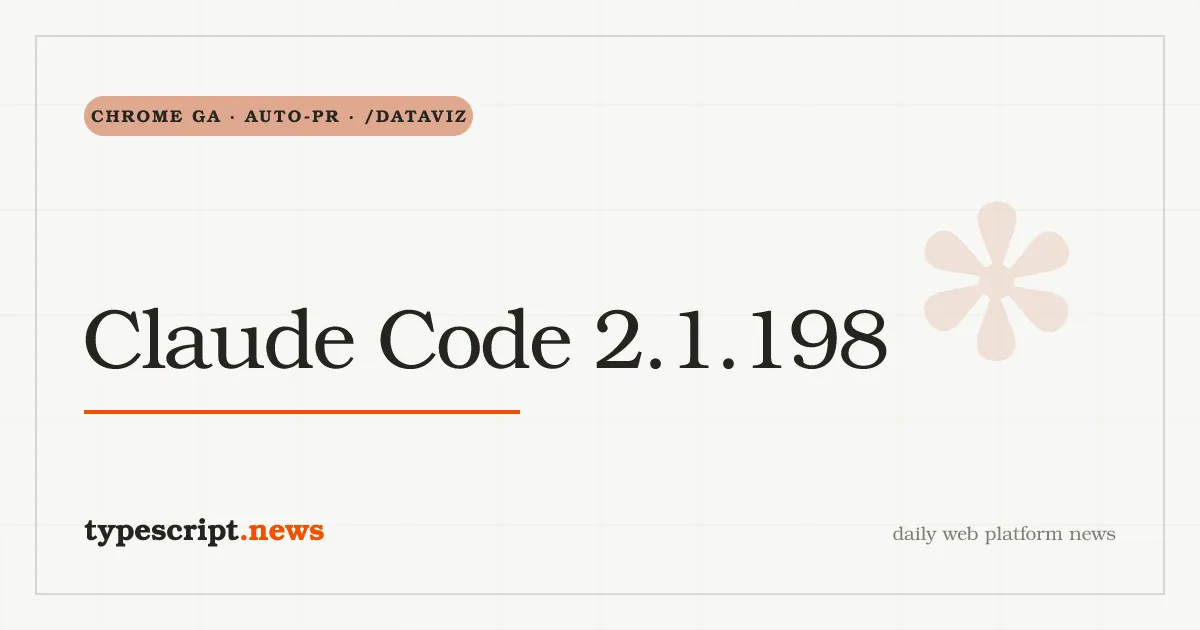
Claude Code v2.1.198 shipped on 2026-07-01T20:45:36Z, one day after v2.1.197 made Sonnet 5 the default model. The release makes Claude in Chrome generally available, lets background agents commit/push/open a draft pull request when they finish code work in a worktree, adds a /dataviz skill for chart and dashboard design, and brings Claude Platform on AWS to the Gateway. The release follows a week of Claude Code activity that started with the v2.1.195 background-agent reliability pass and continued through the v2.1.196 org-default model and MCP trust fix and the v2.1.197 Sonnet 5 default. v2.1.198 is the broadest of the four: it is a feature release that lands end-to-end automation, a GA browser-side assistant, a new Gateway upstream, and a quality-of-output upgrade for the Explore subagent, alongside the usual bug-fix tail.
The Sonnet 5 launch was the bigger individual event this week, and the Claude Code Sonnet 5 default piece covered the v2.1.197 model swap and the cyber safeguards in detail. v2.1.198 is the release that builds the product around Sonnet 5: the GA Chrome experience, the background-agent workflow that runs while the developer is away, the /dataviz skill for the dashboards that the agent now ships, and the Gateway upstream that lets the same session run on Claude Platform on AWS.
Claude in Chrome is now GA inside Claude Code
The headline change is the general availability of Claude in Chrome. The product has been in research preview since August 2025 and was gated behind a feature flag, a waitlist, and the beta-feature warnings on the Claude for Chrome page. v2.1.198 takes the gates off inside Claude Code: the same install path that worked for the beta is now the stable path, the in-product permissions gate is honored across concurrent CLI sessions (closing a regression where the gate was off for second-session CLI), and the tab-group isolation default is preserved. The release keeps the same beta-feature warnings on the Claude for Chrome marketing page because the page documents the standalone Chrome extension; the in-Claude Code integration is what moves to GA.
For Claude Code users, the practical change is that the agent that drives the terminal can now drive a Chrome tab without leaving the session. A user can ask Claude Code to fill a form, click through a multi-page flow, or extract structured data from a page, and the agent handles the browser side the same way it handles the terminal side. The permission model is the same as the beta: tab-group isolation by default, an explicit in-product permission prompt for sensitive actions, and the same browser-context risk warnings. The release does not introduce a new permission tier; it just removes the gates that made the feature inaccessible by default.
Background agents now ship the diff
The biggest product change in v2.1.198 is end-to-end automation for background agents launched from claude agents. Before this release, a background agent that finished code work in a worktree stopped to ask whether to commit, push, or open a pull request. The v2.1.198 release flips the default: the agent commits the changes to its worktree branch, pushes the branch, and opens a draft pull request on the upstream repository. The new Notification hook surface exposes two events for external tools to subscribe to: agent_needs_input (fired when the agent blocks on a question) and agent_completed (fired when the agent finishes, successfully or otherwise). The hook events are the integration point for dashboards, chat pings, and follow-up agents; the auto-PR flow is the integration point for the developer's working repo.
The same release also hardens the background-agent reliability surface. v2.1.198 fixes a regression where background tasks in web, desktop, and VS Code task panels got stuck on Running after they finished or after the session was resumed; a bug where background agents repeatedly showed Reconnecting… every 52 seconds on macOS while the agents view was open; and a deadlock where claude --bg silently created an unattachable session when combined with --print / -p (the conflicting flags are now rejected up front). Agent teams get a fix where a teammate that dies on an API error now reports failed to the lead, and messaging a stuck teammate wakes it to retry immediately. The release also cleans up a leaked worktree registration: locked .git/worktrees/ entries from killed agents are now removed automatically.
/dataviz skill, Gateway on AWS, Explore agent upgrade
Three smaller but practical additions round out the release. The new /dataviz skill gives Claude Code design guidance for charts and dashboards and ships with a runnable color-palette validator. The skill loads on demand when a session is asked to produce a chart or a dashboard and applies the same accessibility, contrast, and color-encoding rules that Anthropic uses internally; the validator accepts a proposed palette and reports whether it clears the contrast and color-blindness thresholds the skill encodes. The skill is additive and lives next to the other built-in skills like /init and /review.
The Claude Code Gateway now accepts Claude Platform on AWS as an upstream provider, exposed under the anthropicAws identifier. Model-not-found responses from one upstream advance the failover chain to the next, so a session that points at multiple providers (for example, Claude Platform on AWS in production and Bedrock in staging) falls through to a working provider when the requested model is unavailable on the first one. The release also fixes a dead-end where Claude Platform on AWS and Mantle sessions landed on 'Please run /login' when the STS token expired: awsAuthRefresh now runs automatically. Remote Control stays disabled when ANTHROPIC_BASE_URL points at a non-Anthropic host, matching the existing behavior under CLAUDE_CODE_USE_BEDROCK / _VERTEX / _FOUNDRY.
The built-in Explore agent, which is the subagent that Claude Code launches for read-only file exploration, now inherits the main session's model (capped at Opus) instead of running on Haiku. The change is a quality-of-output improvement: a Sonnet 5 main session that delegates a codebase-wide exploration to the Explore subagent now gets a Sonnet 5 answer instead of a Haiku answer. The Opus cap is a cost guardrail so a session that picked Opus as the main model does not silently cascade into an Opus-powered Explore pass on every sub-call. Subagents and context compaction also now inherit the parent session's extended thinking configuration, so the delegation does not lose the effort level the main session picked.
Smaller fixes worth flagging
The v2.1.198 release notes close a long tail of small fixes. Brief network drops mid-response (ECONNRESET) now retry with backoff instead of aborting the turn. Excessive background classifier requests when sandboxed processes repeatedly accessed the same network host are fixed. The /diff panel now refreshes when the user switches branches or commits outside the session. Markdown tables no longer overflow and wrap their right border when rendered in fullscreen mode. The /desktop command no longer fails with Cannot determine working directory after entering and exiting a worktree. The workflow progress view no longer drops the earliest agents from the list while the phase counter stays correct in SDK and desktop-app sessions. .claude/rules/ conditional rules now load when the target file is reached via a symlinked path. Plan mode now auto-allows read-only tool calls when a session starts in plan mode. The /branch default fork name is now derived from the first real prompt instead of the compaction summary. Syntax highlighting accuracy in code blocks, diffs, and file previews improves by upgrading to highlight.js 11. Keyboard shortcut hints now show opt/cmd instead of alt/super when connected from a Mac over SSH. The API retry UX shows the error reason after the second attempt and replaces the spinner tip with a status-page link when the API is overloaded. /login now opens the sign-in dialog from the claude agents view instead of saying it is not available. Subagents now treat messages from the agent that launched them as normal task direction; an agent's message is still never treated as the user's approval.
Why this matters for Claude Code users
The v2.1.198 release is the second of two consecutive Claude Code releases that ship Sonnet 5 as the new default. v2.1.197 was the model swap; v2.1.198 is the product that runs on top of the swap. The GA Chrome experience, the background-agent auto-PR workflow, the /dataviz skill, and the Gateway anthropicAws upstream are the four changes that a working Claude Code user notices on a Tuesday morning after claude update. The reliability tail (network-drop retry, STS auto-refresh, worktree registration cleanup, hook events for external tools) is what a team running Claude Code in CI or against a fleet of repos notices over the next month. Both land in the same release, and the release is the broadest feature Claude Code has shipped since the v2.1.196 org-default model and MCP trust fix the day before v2.1.197.
The release also pulls Claude Code closer to a "set it and forget it" workflow for tasks that take longer than a single session. A team that delegates a refactor to a background agent now gets a draft PR in their inbox instead of a stop-to-ask prompt. A team that wants to track background agents across multiple repositories can wire the new Notification hook events into a dashboard. A team that runs Claude Code against a Chrome tab now has the GA version of the feature instead of a research preview. The release is the first one in 2026 where the headline changes are about delegation and integration rather than about the model itself, and it sets the template for the next release cycle: the model is settled, and the work is on the product around it.