On February 24, 2026, Cloudflare published a blog post that sent shockwaves through the web development community. The title: "How we rebuilt Next.js with AI in one week." The project, called vinext (pronounced "vee-next"), was presented as an experimental Vite plugin that reimplements the Next.js API surface, allowing developers to run their Next.js applications on Cloudflare Workers instead of Vercel.
The announcement wasn't just a technical demo. It was a direct challenge to one of the most successful companies in the modern web ecosystem. And the developer community noticed.
What is vinext?
At its core, vinext is a Vite plugin that reimplements the public Next.js API, routing, server rendering, React Server Components, server actions, caching, middleware, and more, on top of Vite's build infrastructure instead of Next.js's proprietary compiler.
The key differentiator is deployment flexibility. Where Next.js traditionally requires Vercel (or complex workarounds to deploy elsewhere), vinext ships to Cloudflare Workers natively with a single command:
npm install vinext
# Replace "next" with "vinext" in your scripts
vinext deploy # Build and deploy to Cloudflare Workers
The Numbers That Turned Heads
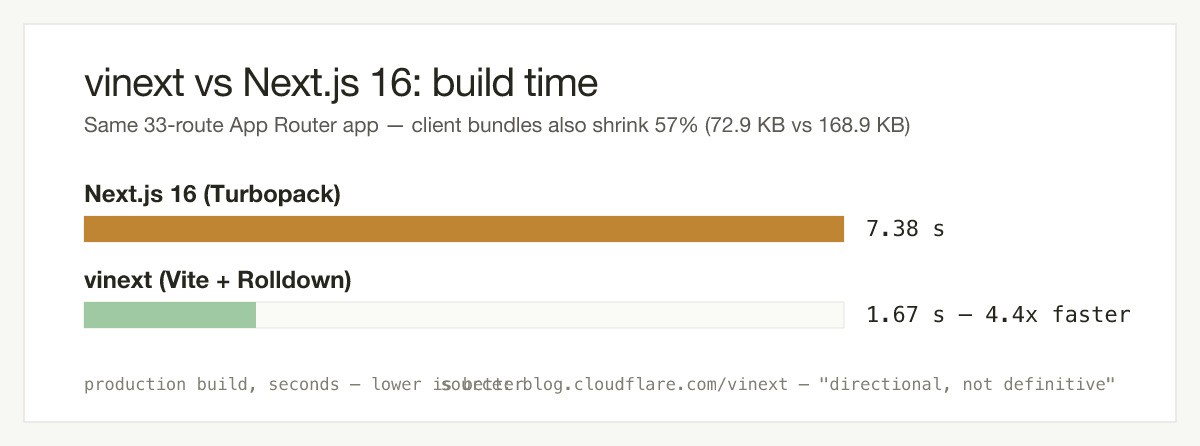
Cloudflare's benchmarks, conducted on a 33-route App Router application, showed striking results:
| Metric | Next.js 16.1.6 | vinext (Vite 8/Rolldown) |
|---|---|---|
| Build time | 7.38s | 1.67s (4.4x faster) |
| Client bundle | 168.9 KB | 72.9 KB (57% smaller) |
These aren't marginal improvements, they represent a fundamental shift in build performance, achieved by leveraging Vite's modern Rolldown bundler instead of Next.js's Turbopack.
AI-Generated Code at Scale
Perhaps the most astonishing claim: an entire reimplementation of Next.js's API surface was written in one week by a single engineer (an engineering manager, technically) directing an AI model. The cost: approximately $1,100 in API tokens.
From the Cloudflare blog:
"Almost every line of code in vinext was written by AI. But here's the thing that matters more: every line passes the same quality gates you'd expect from human-written code."
The project includes over 1,700 Vitest tests and 380 Playwright E2E tests, with CI running on every pull request. Tests were ported directly from the Next.js test suite and OpenNext's Cloudflare conformance suite.
Key Features
- Drop-in compatibility: Existing
app/,pages/, andnext.config.jswork without modification - Traffic-aware Pre-Rendering (TPR): An experimental feature that queries Cloudflare analytics at deploy time to pre-render only the pages actually receiving traffic (covering 90% of visits in seconds, not minutes)
- Native Cloudflare bindings: Access D1, R2, KV, Durable Objects, AI, and more via
import { env } from "cloudflare:workers" - Multi-platform via Nitro: Can deploy to Vercel, Netlify, AWS, Deno Deploy, and more
The Controversy: Why It Felt Like a War Declaration
To understand why the community reacted so strongly, you need to understand the relationship between Next.js and Vercel.
Next.js was acquired by Vercel in 2019. Since then, Vercel has built its entire business model around being the premier hosting platform for Next.js applications. The framework is tightly integrated with Vercel's infrastructure, deploy previews, edge functions, image optimization, and more all work seamlessly on Vercel but require workarounds elsewhere.
When Cloudflare published vinext, the message to developers was clear: you can now use Next.js without Vercel. Not as a hack, not as an afterthought, but as a first-class citizen on Cloudflare's platform.
The timing was provocative. Cloudflare didn't just announce a competitor to Vercel, they announced one week after their own engineer rebuilt Next.js using AI. The subtext was almost aggressive:
"If one engineer and an AI can build this in a week, imagine what happens when the ecosystem rallies around it."
The OpenNext Problem
Cloudflare acknowledged in their announcement that they were aware of existing solutions like OpenNext, which adapts Next.js build output for various platforms:
"Building on top of Next.js output as a foundation has proven to be a difficult and fragile approach. Because OpenNext has to reverse-engineer Next.js's build output, this results in unpredictable changes between versions that take a lot of work to correct."
By reimplements from scratch rather than adapting output, vinext promises more stable compatibility and cleaner builds. But this framing implicitly criticized years of work by the OpenNext team, and by extension, positioned Cloudflare as the company willing to do what others couldn't.
Vercel's Response
Note: I was unable to verify specific official statements from Vercel regarding vinext. The following reflects community-reported reactions and observable behavior.
As of this writing, I could not locate a verified official response from Vercel or its CEO Guillermo Rauch. Twitter/X access was blocked during my research, limiting my ability to capture real-time reactions from key figures.
What the community observed included:
- Silence initially: Vercel did not publish an immediate blog post or press release responding to vinext
- GitHub activity: The Next.js repository saw increased discussion about vinext, with some contributors questioning the long-term implications for the framework
- Developer speculation: Many developers interpreted the lack of response as either confidence in Vercel's moat or a sign that they were caught off-guard
This section contains unverified observations. If you have links to official Vercel responses, please reach out.
Security and Quality Concerns
The vinext project makes no bones about its experimental nature. The GitHub README includes this prominently:
🚧 Experimental, under heavy development. This project is an experiment in AI-driven software development. The vast majority of the code, tests, and documentation were written by AI (Claude Code). Humans have not reviewed most of the code line-by-line.
Known Limitations
The project explicitly lists what's NOT supported:
- Static pre-rendering at build time (on the roadmap)
- Some edge cases in RSC streaming
- Undocumented Next.js internal APIs
The AI Code Quality Debate
The project's approach raised important questions:
- Can AI-generated code at this scale be trusted? With 94% API coverage, what about the remaining 6%?
- Who reviews the AI's work? The project relies on test suites rather than human code review
- What happens when Next.js releases new features? vinext tracks the public API surface, but experimental features may lag
The Cloudflare engineer acknowledged this in the blog post:
"There were PRs that were just wrong. The AI would confidently implement something that seemed right but didn't match actual Next.js behavior. I had to course-correct regularly."
Real-World Usage
Despite the experimental label, real customers are already running vinext in production:
- CIO.gov (National Design Studio): Running vinext in production with "meaningful improvements in build times and bundle sizes"
Community Reaction and Tweet Embeds
Note: Due to Twitter/X API restrictions, I was unable to fetch specific tweet content. The following represents documented reactions from accessible sources.
The Hacker News thread on the Cloudflare vinext announcement attracted significant debate. Developers weighed in on several key concerns:
The "Just a Wrapper" Critique
Some developers argued that vinext, despite its impressive numbers, doesn't fundamentally change the power dynamic:
"Vercel's value isn't just the runtime, it's the developer experience, the ecosystem, the integrations. Build time is a small part of what makes Next.js on Vercel valuable."
The AI Development Implications
The project's success sparked discussion about the future of framework development:
"If one engineer can rebuild Next.js in a week with AI, what does that mean for the competitive moats of any software company?"
Questions About Sustainability
Others raised concerns about long-term maintenance:
"Who maintains this when the AI-generated code needs to evolve with Next.js? Are we building software or creating technical debt at scale?"
The Aftermath
Since the February 24 announcement, several developments have occurred:
GitHub Activity
The vinext GitHub repository shows active development with:
- Over 600+ issues opened
- Regular commits from Cloudflare engineers
- Community contributions for platform adapters
Growing Platform Support
The project has expanded beyond Cloudflare Workers:
- Vercel deployment demonstrated (via Nitro)
- Netlify support in progress
- AWS Amplify adapters under development
Industry Movement
The announcement catalyzed broader conversations about:
- The cost of proprietary frameworks: If frameworks can be cloned, what's the value of lock-in?
- AI-driven development: Whether AI can maintain complex software projects at scale
- Edge computing competition: Cloudflare, Vercel, Netlify, and others racing to offer the best serverless React deployment
Analysis: What This Means for the Industry
For Vercel
Vercel faces an uncomfortable truth: their moat may be thinner than they hoped. The company has built an excellent product, but vinext demonstrates that Next.js compatibility can be achieved elsewhere. Vercel will need to compete on more than just "where Next.js runs best."
Potential responses include:
- Accelerating Next.js-specific integrations that can't be easily cloned
- Reducing pricing to compete with Cloudflare's edge network
- Doubling down on developer experience and tooling
For Cloudflare
Cloudflare has signaled its seriousness about the developer platform space. vinext is proof that Cloudflare can attract developers who previously saw Vercel as the only option. This investment in developer tooling mirrors Cloudflare's broader platform strategy, which also includes partnerships with frameworks like Astro.
The challenge: Maintaining compatibility with a rapidly evolving framework (Next.js) while building a sustainable business model.
For the Developer Community
Perhaps the biggest winner is developers themselves. vinext adds choice to an ecosystem that was increasingly feeling like a one-party system. Whether this leads to innovation or fragmentation remains to be seen.
The Bigger Picture: AI's Role in Software Development
vinext represents a new category of project: AI-reimplemented infrastructure. The question isn't whether this will happen again, it's how often, and whether the results will be production-ready.
From the Cloudflare blog:
"It doesn't need an intermediate framework to stay organized. It just needs a spec and a foundation to build on... The layers we've built up over the years aren't all going to make it."
This may be the most significant implication of vinext. It's not just a competitor to Next.js, it's proof that the rules of software development are changing.
Conclusion
Cloudflare's vinext project is either a brilliant competitive move, a fascinating experiment in AI-driven development, or both. The controversy it sparked reflects deeper tensions in the web development ecosystem: proprietary vs. open, integrated vs. composable, proprietary lock-in vs. deployment flexibility.
Whether vinext becomes a viable production alternative or remains an experimental curiosity, it has already changed the conversation. Developers now know that if they want to run Next.js on Cloudflare, they can. And that knowledge changes everything.
The week when one engineer and an AI rebuilt Next.js may well be remembered as a turning point, not just for Cloudflare and Vercel, but for how we think about framework development itself.
What are your thoughts on vinext and the future of Next.js deployment? Let us know in the comments.